Natural vs Synthetic Vitamin E: What Formulators Need to Know
For supplement and food formulators, comparing natural vs synthetic vitamin E involves more than identifying an ingredient´s source. The two forms differ in molecular structure, biological activity, sourcing, and manufacturing process. These differences can influence fortification calculations, ingredient selection, and product positioning.
Natural vs synthetic vitamin E: What is the difference?
Vitamin E is not a single molecule. It is a family of eight naturally occurring compounds: four tocopherols (alpha, beta, gamma, and delta) and four corresponding tocotrienols. Among the tocopherols, alpha-tocopherol (RRR-alpha-tocopherol) has the highest recognized vitamin E activity.
The key difference between natural and synthetic alpha-tocopherol is stereochemistry.
Natural vitamin E contains RRR-alpha-tocopherol, the single form found in nature and preferentially retained by the body. Meanwhile, synthetic vitamin E, known as all-rac-alpha-tocopherol, contains a mixture of eight different stereoisomers, which means only 12.5% of the synthetic mixture is the RRR configuration found in natural vitamin E; the remaining stereoisomers have different levels of biological activity.1
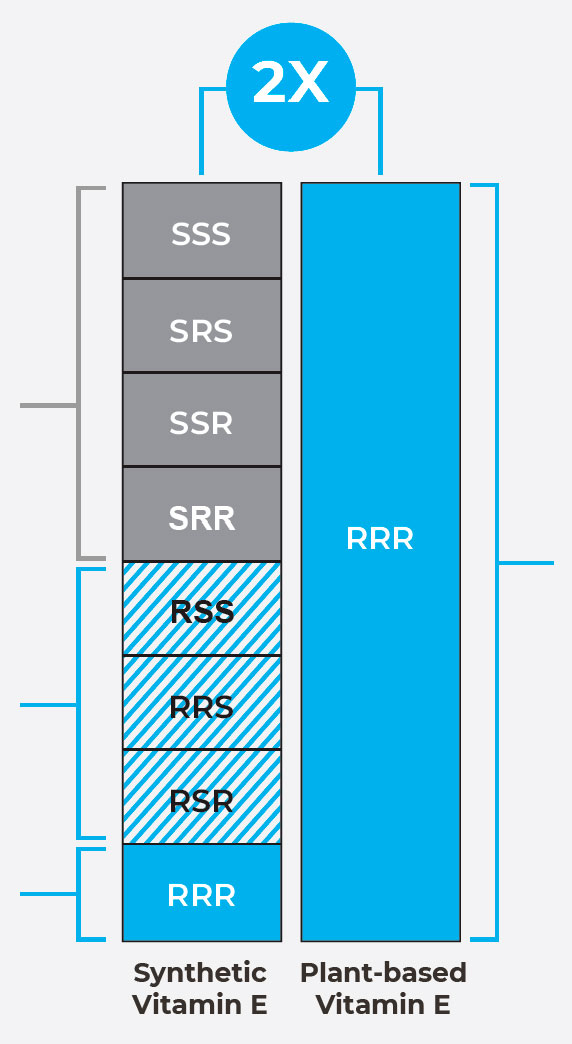
This difference in molecular structure matters because the body does not handle all stereoisomers in the same way, which affects vitamin E bioavailability, as explained below.
d-alpha vs dl-alpha tocopherol: Understanding the terminology
The terms d-alpha and dl-alpha tocopherol are commonly used in ingredient specifications and product literature. In practical terms, d-alpha-tocopherol refers to natural RRR-alpha-tocopherol, while dl-alpha-tocopherol refers to synthetic all-rac-alpha-tocopherol. Recognizing these names is the first step in comparing natural vs synthetic vitamin E across supplier specifications. Both forms are also commonly supplied as esters, such as d-alpha-tocopheryl acetate or succinate (natural) and dl-alpha-tocopheryl acetate (synthetic), which are more stable during processing and storage.
| Natural Vitamin E | Synthetic Vitamin E | |
|---|---|---|
| Common name | d-alpha-tocopherol | dl-alpha-tocopherol |
| Scientific name | RRR-alpha-tocopherol | all-rac-alpha-tocopherol |
| Stereochemistry | One RRR stereoisomer | Mixture of eight stereoisomers |
| RRR content | 100% RRR-alpha-tocopherol | 12.5% RRR-alpha-tocopherol |
| Production | Isolated from plant sources such as vegetable oils | Produced by chemical synthesis |
| Vitamin E activity (US basis) | 1 mg = 1.0 mg RRR-α-TE | 1 mg = 0.50 mg RRR-α-TE |
What does research show about natural vitamin E bioavailability?
Research into natural vitamin E bioavailability has consistently focused on the different ways the body absorbs, retains, and distributes natural RRR-alpha-tocopherol versus synthetic all-rac-alpha-tocopherol. Human research using deuterium-labeled forms of natural and synthetic vitamin E has demonstrated preferential retention of RRR-alpha-tocopherol. In Burton et al., the plasma ratio of natural to synthetic alpha-tocopherol approached 2:1 after dosing ended, while tissue ratios varied with dose and study duration.2
“The results indicated that natural vitamin E has roughly twice the availability of synthetic vitamin E.”2
In other words, the body retains natural vitamin E preferentially over synthetic vitamin E. Natural Vitamin E has much higher bioavailability than synthetic Vitamin E. The biological explanation relates in part to liver metabolism. After absorption, alpha-tocopherol passes through the liver, where the alpha-tocopherol transfer protein (α-TTP) selectively incorporates alpha-tocopherol into circulating lipoproteins and favors stereoisomers with the 2R configuration, such as RRR-alpha-tocopherol. Unselected forms are more readily metabolized and excreted. 3
What does this mean for your formulation?
The 2:1 figure describes how efficiently the body retains each form, so it should not be read as twice the health benefits, and it can vary between plasma and tissues. Research on long-term health outcomes is still evolving, as a review by Ranard and Erdman points out.4 Where natural vitamin E makes a clear difference today is in the formula itself: because the body favors RRR-alpha-tocopherol, choosing the natural form lets you reach your target vitamin E activity with fewer ingredients, using the form the body preferentially retains.
How to choose plant-based vitamin E for supplements, foods, and beverages?
Vitamin E is naturally present in foods such as vegetable oils, nuts, seeds, and green vegetables. As a fat-soluble vitamin, it is absorbed with dietary fats, so both the delivery format and overall formulation are important considerations when developing supplements and fortified foods.
Safety and intended intake also require consideration. EFSA set a tolerable upper intake level of 300 mg/day of vitamin E for adults, including pregnant and lactating women, which applies to all stereoisomeric forms and to intake from all sources, with lower age-specific ULs established for children and infants.5 This upper intake level is a safety reference, not a recommended dose, a formulation target, or a legal maximum per product.
Selecting a vitamin E ingredient depends on more than intake level alone. The right choice depends on vitamin E’s purpose in the formulation. Start by defining the ingredient’s role: nutritional fortification, antioxidant protection of the finished product, or both. Then consider the delivery format, processing conditions, and sourcing preferences that matter to your brand and customers.
Nutritional fortification
When formulating fortified foods or supplements, the difference between RRR-alpha-tocopherol and all-rac-alpha-tocopherol affects how much ingredient is required to reach the intended fortification level.
Format matters too. Depending on the application and manufacturing process, formulators may need an oil, a powder, or a spray-dried format. Kensing offers natural RRR-alpha-tocopherol through Sun E®, its sunflower-sourced vitamin E range, as well as Covitol®, a broader portfolio of natural-source vitamin E in multiple formats for dietary supplement and food applications.
Antioxidant protection
Vitamin E can also play a very different role in a formulation: protecting the product itself from oxidation.
While RRR-alpha-tocopherol is particularly relevant when the primary goal is vitamin E fortification, mixed tocopherols are commonly used as natural antioxidants to help protect fats and oils from oxidative rancidity.6 They can help extend shelf life and support the retention of flavor, color, texture, and other oxidation-sensitive components.
Kensing’s Covi-ox® portfolio provides plant-based mixed tocopherols for antioxidant protection, while Nutripherol® combines two functions in one solution sourced from non-GMO European rapeseed: antioxidant protection against oxidative rancidity and vitamin E fortification.
Sourcing and product positioning
Origin can also influence product positioning. Synthetic vitamin E is typically produced through chemical synthesis and can originate from petrochemical raw materials.
At Kensing, we focus on natural, plant-based sources such as sunflower, soy, and rapeseed, among others. In many cases, we obtain our vitamin E from upcycled side streams of vegetable-oil processing, helping transform existing plant-based resources into high-value nutritional ingredients.
This gives formulators additional options when building products around natural origin, plant-based sourcing, and clean-label products.
Explore Kensing’s Plant-Based Vitamin E Portfolio
Your formulation goals guide our approach. We work with you to identify plant-based vitamin E solutions that fit your application, processing requirements, and sourcing preferences, supporting your clean-label product development goals.
Looking for a plant-based vitamin E source for your next dietary supplement or fortified food or beverage?
References
1- Lodge JK. Vitamin E bioavailability in humans. J. Plant Physiol. 2005;162(7):790–796. Hoppe PP, Krennrich G. Bioavailability and potency of natural-source and all-racemic alpha-tocopherol in the human: a dispute. Eur J Nutr. 2000 Oct;39(5):183-93.
2- “Human plasma and tissue alpha-tocopherol concentrations in response to supplementation with deuterated natural and synthetic vitamin E”. G W Burton, M G Traber, R V Acuff, D N Walters, H Kayden, L Hughes, K U Ingold. Am J Clin Nutr. 1998;67(4):669–684. DOI: 10.1093/ajcn/67.4.669
3- “The molecular basis of vitamin E retention: structure of human alpha-tocopherol transfer protein”. Reto Meier, Takashi Tomizaki, Clemens Schulze-Briese, Ulrich Baumann, Achim Stocker. J Mol Biol. 2003;331(3):725–734. DOI: 10.1016/s0022-2836(03)00724-1
4- “Effects of dietary RRR α-tocopherol vs all-racemic α-tocopherol on health outcomes”. Kathryn M Ranard, John W Erdman Jr. Nutr Rev. 2018;76(3):141–153. DOI: 10.1093/nutrit/nux067
5- “Scientific opinion on the tolerable upper intake level for vitamin E”. EFSA Panel on Nutrition, Novel Foods and Food Allergens (NDA), Dominique Turck, Torsten Bohn, Jacqueline Castenmiller, Stefaan de Henauw, Karen Ildico Hirsch-Ernst, et al. EFSA J. 2024;22(8):e8953 (adopted 28 June 2024). https://efsa.onlinelibrary.wiley.com/doi/10.2903/j.efsa.2024.8953
6- “The chemistry and antioxidant properties of tocopherols and tocotrienols”. Afaf Kamal-Eldin, Lars-Åke Appelqvist. Lipids. 1996;31(7):671–701. DOI: 10.1007/BF02522884


